Labels

Monday, November 18, 2019

Lab #3 – Calculating Work

Lab #3 – Calculating Work

Work = Force x distance
Work = (Force)(Distance)
W = Fd

Problem
How can we use a ramp to help us pull a weight up to a certain height with the least amount of work possible?


Hypothesis: If I use a ramp to pull the weight up to the SAME height (distance), then....   harder? easier?  no difference?   and this is my reasoning....

Materials
Ruler, chair, ramp (inclined plane), weights, spring scale

Procedure

Results
A.  Work done without ramp
Object
Force (Newtons)
Distance (cm)
Work (Joules)
a. __g Weight
__N
__cm
___J
b. __g Weight


c. __g Weight


d. __g Weight


Calculate the average work done without a ramp: _____Joules

B.  Work done with ramp
Object
Force (Newtons)
Distance (cm)
Work (Joules)
a. __g Weight
 N
cm 
b. __g Weight


c. __g Weight


d. __g Weight


Calculate the average work down using a ramp:
_____Joules

 
ANALYSIS
1)   Make a bar graph titled, "Bar graph comparing work done without a ramp vs work done with a ramp".
x axis: 2 bars = no ramp vs ramp
y axis: average amount of work done in Joules

2)   How did the weight (force pulling down) affect the amount of work done on the object?

3) a.Where does your data indicate that using a simple machine (inclined plane) makes work easier, using a ramp or no ramp?
    b. Which saves you energy, using a ladder or using the stairs?  Use evidence from your results!!!

4)   Part 1 (A,B): What is your Independent Variable?
5)   Part 1 (A,B): What is your Dependent Variable?
6)   Part 1 (A,B): What are your Constants?

Conclusion
 Restate the problem in your own words.
 My hypothesis (is/is not supported) because__________________________.
Briefly describe your procedure i.e. what were the steps you took to complete the investigation?  (Think of a following a recipe when you cook!)
If I had the opportunity to complete this lab again, I would change _________ because________________
 What did you learn in this lab?
 What did you like about this lab?
 What were some challenges you had to deal with?  My sources of error for the lab were _____________because____________. 
 What could you do next with this problem?  What other tests could you perform?
 Write down any other additional thoughts, observations, inferences, etc.

http://mrconsidinescience.blogspot.com/


Make another Hypothesis: Use your hands to feel the sandpaper.  Will the sandpaper cause more work, less work or no change to be done on the weights? 

C.  Work done with ­­­­sandpaper and ramp
Object
Force (Newtons)
Distance (cm)
Work (Joules)

a. __ g Weight


b. __ g Weight


c. __ g Weight


d. __ g Weight


Calculate the average work done using a different surface: _____Joules

7)   Part 2 (B,C): What is your Independent Variable?
8)   Part 2 (B,C): What is your Dependent Variable?
9)   Part 2 (B,C): What are you Constants?
10) Make a bar graph titled, "Bar graph comparing work done with ramp surface vs work done with sandpaper"
x axis: 2 bars = ramp surface vs sandpaper
y axis: average amount of work done in Joules

Wednesday, November 13, 2019

November Current Events Science Article


1.  Insect zombies are the stuff of nightmares
https://newsela.com/read/wasp-insect-zombies/id/2000001326/

2. Facts about the moon
https://newsela.com/read/lib-facts-about-the-moon/id/57210/

3. Warming climate making sea turtles almost all girls

4. These creepy lemurs are the only six-fingered primates on Earth

5. The mystery ingredient holding up walls in China is in your rice bowl

6. The moon has power over animals

7. Sunflower-like rods could boost efficiency of solar collectors

8. Health risks are scaring some teen vapers into considering quitting

9. Groundwater pumping is draining rivers and streams worldwide


10. Exploring the amazing world of lichens

11.  Delivery Drones May Finally Become A Reality In The US Skies


4
3
2
1
0
Total Points
Heading, Neatness, Overall Organization
The loose leaf is neat, the heading is legible, the work is organized
There is some disorganization. 

Parts of the heading are missing.
There is no heading.  The loose leaf is torn.  It is disorganized.

Summary explaining the main idea
There are at least five sentences in the summary paragraph
There are only four sentences in the summary paragraph
There are only three sentences in the summary paragraph
There are only one to two sentences in the summary paragraph.
There is no summary.

1)How is it science related? 2) Why is this important? 3) How does this affect us?
All of the Science questions have been answered.
Two of the three Science questions have been answered.
One of the Science questions has been answered.
The questions have not been answered properly, they have been copied, etc.
None of the Science questions has been answered.

Science word dictionary definition
There is a Science word from the article that has a proper dictionary definition.


There is no definition, it has been made up, the word is not from the article, etc.

Science illustration
There is a student constructed Science illustration with color.
There is a student constructed Science illustration with no color.
There is a printed out Science illustration.
Minimal effort has been put into the Science illustration.
There is NO Science illustration.

Thursday, November 7, 2019

C3 - Videos

A. Inclined Planes make work easier. 

1. How many Newtons of force is it to lift the barrel onto the truck?
2. ______ is the ability to do work.
3. Work = _____ x _______
4. It would take ___Joules of work to lift the barrel onto the truck.
5. The ________ from the ground to the truck is 1 meter.
6. A machine helps us use our energy more efficiently. (True/False)
7. Give three examples of an inclined plane.


B.  Pushing and Pulling - Force, Work and Energy


1. A force can move a __________ object or stop a ______ object.
2. Describe how using a force can change the shape of an object.  Draw a picture.
3. Work can be calculated using the formula: ____ = _____x________. 
4. True/False: Food gives us the chemical energy we need to do work


Tuesday, October 29, 2019

Science Article: Energy Resources

1. Future of renewable energy looks bright thanks to solar plane's journey

2. Ten interesting things about energy

3. Commuter bus runs on human waste

4. How human waste could power global agriculture

5. Eight exciting energy alternatives for the future


6. Consumer Reports Survey Finds Most Americans Want More Renewable Energy 
https://cleantechnica.com/2018/11/05/consumer-reports-survey-finds-most-americans-want-more-renewable-energy/

7.  Disney’s New 270-Acre Solar Farm Can Power Two Of Its Theme Parks
https://cleantechnica.com/2019/02/22/disneys-new-270-acre-solar-farm-can-power-two-of-its-theme-parks/

8. Ocean energy could be the wave of the future
Wave-power systems are the latest in clean, renewable energy


4
3
2
1
0
Total Points
Heading, Neatness, Overall Organization
The loose leaf is neat, the heading is legible, the work is organized
There is some disorganization. 

Parts of the heading are missing.
There is no heading.  The loose leaf is torn.  It is disorganized.

Summary explaining the main idea
There are at least five sentences in the summary paragraph
There are only four sentences in the summary paragraph
There are only three sentences in the summary paragraph
There are only one to two sentences in the summary paragraph.
There is no summary.

1)How is it science related? 2) Why is this important? 3) How does this affect us?
All of the Science questions have been answered.
Two of the three Science questions have been answered.
One of the Science questions has been answered.
The questions have not been answered properly, they have been copied, etc.
None of the Science questions has been answered.

Science word dictionary definition
There is a Science word from the article that has a proper dictionary definition.


There is no definition, it has been made up, the word is not from the article, etc.

Science illustration
There is a student constructed Science illustration with color.
There is a student constructed Science illustration with no color.
There is a printed out Science illustration.
Minimal effort has been put into the Science illustration.
There is NO Science illustration.


Monday, October 21, 2019

Energy transforms...

Read the following information about the Forms of Energy and watch the following videos, then watch this https://www.brainpop.com/science/energy/formsofenergy/ video, take the "graded quiz" and record your score in your Science Notebooks.

from www.dictionary.com:
energy  (Ä›n'É™r-jÄ“) Pronunciation Key 
The capacity or power to do work, such as the capacity to move an object (of a given mass) by the application of force. Energy can exist in a variety of forms, such as electrical, mechanical, chemical, thermal, or nuclear, and can be transformed from one form to another. It is measured by the amount of work done, usually in joules or watts.

 Forms of Energy
Energy can come in a variety of forms.

1. Radiant Energy - is light energy, that when absorbed by an object, gets converted to thermal/heat energy.
 Examples: A light bulb, the glowing coils on a toaster, the sun, and even headlights on cars. 
sunrise dawn GIF


2. Thermal Energy - is the energy of molecular movement; it's heat energy. The faster the molecules move, the more thermal energy is present.  Heat is the transfer of thermal energy i.e. when thermal energy moves from object to object, we feel it as heat.


3. Chemical Energy - is really a form of potential energy and is the energy stored in food, gasoline or chemical bonds.
Examples: Striking a match, food, batteries.  


4. Electrical Energy - Energy produced by electrons moving through a substance is known as electrical energy. We see evidence of electricity in household appliances, electric outlets, phone chargers, electric wires. 
Examples: MP3 players, computers, video games, holiday light wires.


5. Mechanical Energy - is the energy of movement. All moving objects have mechanical energy. Examples: bicycles, machine parts, subway trains, wheels, us!
M.E. = P.E. + K.E.


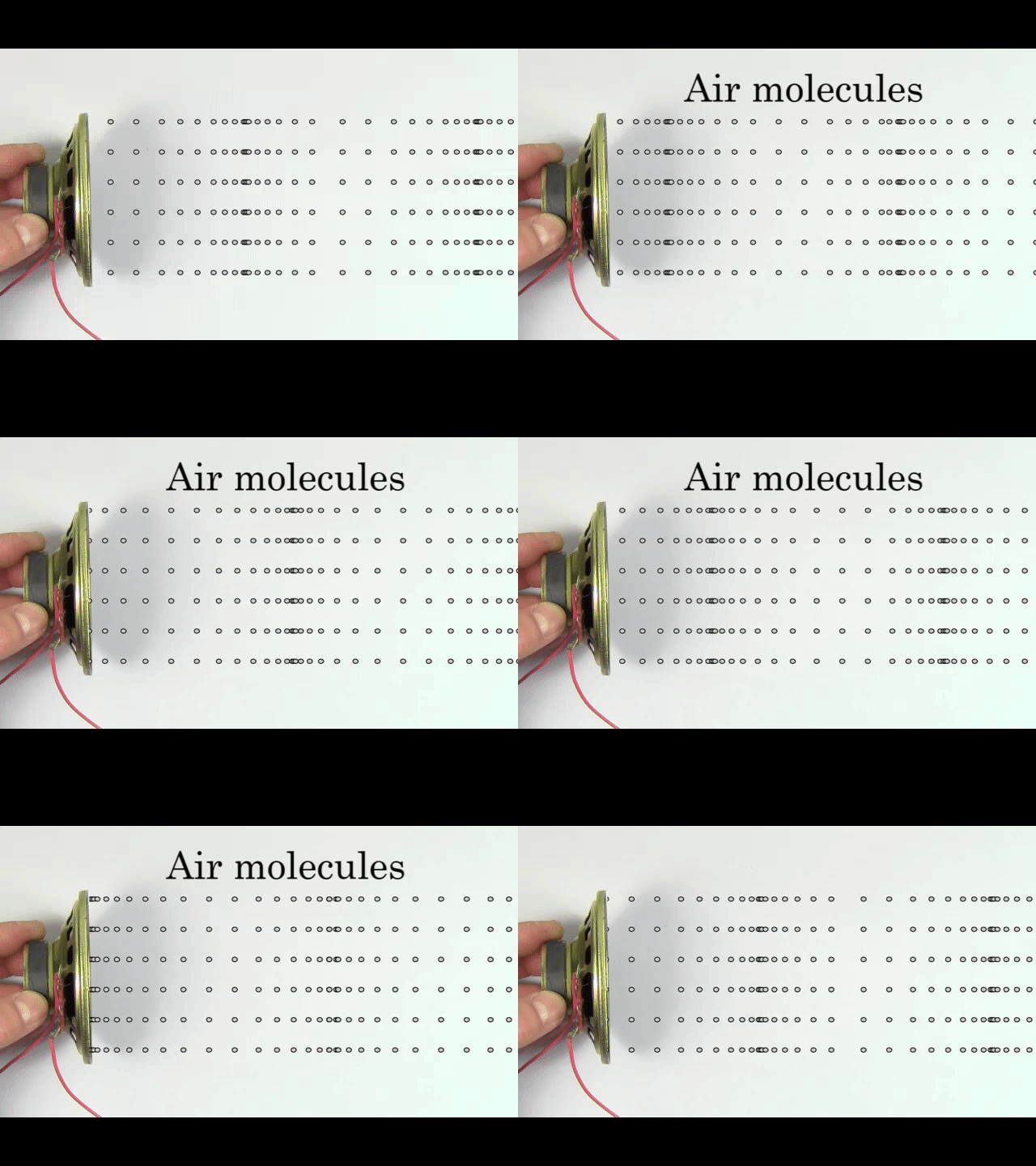
6. Sound Energy- is produced when a solid, liquid or gas vibrates. Sound energy travels out as waves in all directions.
Examples: Voices, sirens, horns and musical instruments.


 6. 


C. Generating Electricity!!!

- Electrical energy is needed in our daily lives.  Imagine what life would be like if all those appliances that you plug in on a daily basis were to disappear...   No refrigerators, no phones, no television, no hot water, etc.


Power plants use a generator to generate electricity.  A turbine turns the generator.  Mechanical energy is needed to turn the turbine, usually in the form of steam pushing against its blades.  Now, all we need is a source of thermal energy to boil the water into a gas.


Energy exploration websites
***http://www.solpass.org/5s/AP/4.2scienceactivity.htm***