Taxonomy
- the science of classifying organisms
Common
Names
|
spider
monkey
|
sea monkey
|
sea horse
|
|
gray wolf
|
Firefly
|
Crayfish
|
|
mud puppy
|
horned toad
|
Ringworm
|
|
black bear
|
Jellyfish
|
|
*Common
names can be confusing and names can vary by region.
Why Classify?
About 1.5
million species named
2-100 million species yet to be discovered
Taxonomy =science of classifying organisms
--groups similar organisms together
--assigns each a name
Naming Organisms:
Organisms have common & scientific name -all organisms have only 1
scientific name
-usually Latin or Greek
-developed by Carolus Linnaeus
|
The scientific name
is always italicized or underlined. Genus is capitalized. Species is not.
Scientific names can be abbreviated by using the capital letter of the genus
and a period: Example.P. leo (lion)
Members of the same
genus are closely related.
Only members of the same species can interbreed (under natural conditions)
Some hybrids do occur under unnatural conditions: Ligers are crosses between
tigers and lions.
|
This
two-word naming system is called
Binomial Nomenclature
-written
in italics (or underlined)
-1st word is Capitalized --Genus
-2nd word is lowercase ---species
Examples: Felis concolor, Ursus arctos, Homo sapiens,Panthera leo , Panthera tigris
Linneaus
- devised the current system of classification, which uses the following schema
|
Kingdom
|
|
|
|
|
|
|
|
Phylum/Division
|
|
|
|
|
|
|
|
Class
|
|
|
|
|
|
|
|
Order
|
|
|
|
|
|
|
|
Family
|
|
|
|
|
|
|
|
Genus
|
|
|
|
|
|
|
|
Species
|
|
Human
|
Cougar
|
Tiger
|
Pintail
Duck
|
|
Kingdom
|
Animalia
|
Animalia
|
Animalia
|
Animalia
|
|
Phylum/Division
|
Chordata
|
Chordata
|
Chordata
|
Chordata
|
|
Class
|
Mammalia
|
Mammalia
|
Mammalia
|
Aves
|
|
Order
|
Primate
|
Carnivora
|
Carnivora
|
Anseriformes
|
|
Family
|
Homindae
|
Felidae
|
Felidae
|
Anatidae
|
|
Genus
|
Homo
|
Felis
|
Panthera
|
Anas
|
|
Species
|
sapiens
|
concolor
|
tigris
|
Acuta
|
18-2
Modern Evolutionary Classification
- Linnaeus grouped species mainly
on visible similarities & differences
- Today, taxonomists group
organisms into categories that represent lines of evolutionary descent
(phylogeny)
- Evolutionary relationships among
a group of organisms can be shown on a cladogram
Similarities
in DNA and RNA
- DNA & RNA is similar across
all life forms
- Genes of many organisms show
important similarities at the molecular level
- DNA shows evolutionary
relationships & helps classify organisms
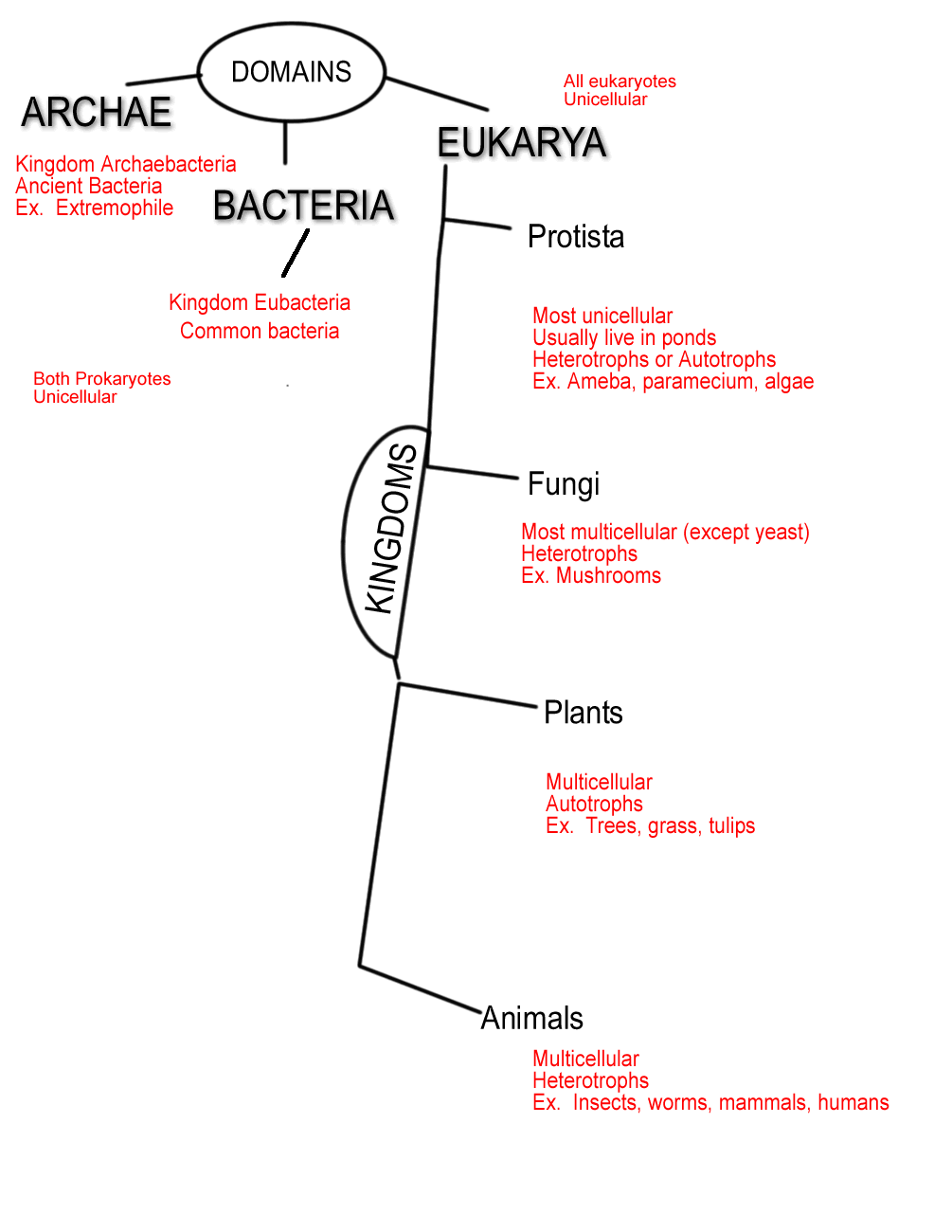
The Six
Kingdoms and Domains
|
number
of Cells
|
Energy
|
cell
type
|
Examples
|
|
archaebacteria
|
Unicellular
|
some
autotrophic, most chemotrophic
|
Prokaryote
|
"extremophiles"
|
|
Eubacteria
|
Unicellular
|
autotrophic
and heterotrophic
|
Prokaryote
|
bacteria,
E. coli
|
|
Fungae
|
most
multicellular
|
Heterotrophic
|
Eukaryote
|
mushrooms,
yeast
|
|
Plantae
|
Multicellular
|
Autotrophic
|
Eukaryote
|
trees,
grass
|
|
Animalia
|
Multicellular
|
Heterotrophic
|
Eukaryote
|
humans,
insects, worms
|
|
Protista
|
most
unicellular
|
heterotrophic
or autotrophic
|
Eukaryote
|
ameba,
paramecium, algae
|
Using
Dichotomous Keys
A
dichotomous key is a written set of choices that leads to the name of an
organism. Scientists use these to identify unknown organisms.
Consider
the following animals. They are all related, but each is a separate species.
Use the dichotomous key below to determine the species of each.
|
1.
|
Has green
colored body ......go to 2
|
|
Has purple
colored body ..... go to 4
|
|
2.
|
Has 4 legs
.....go to 3
|
|
Has 8 legs
.......... Deerus octagis
|
|
3.
|
Has a tail
........ Deerus pestis
|
|
Does not
have a tail ..... Deerus magnus
|
|
4.
|
Has a
pointy hump ...... Deerus humpis
|
|
Does not
have a pointy hump.....go to 5
|
|
5.
|
Has ears
.........Deerus purplinis
|
|
|
Does not
have ears ......Deerus deafus
|
|
|
|
Answers:
A. Deerus magnus
B. Deerus pestis
C. Deerus octagis
D. Deerus purplinis
E. Deerus deafus
F. Deerus humpis
*note
that all of these organisms are in the same genus.