Wednesday, March 13, 2019
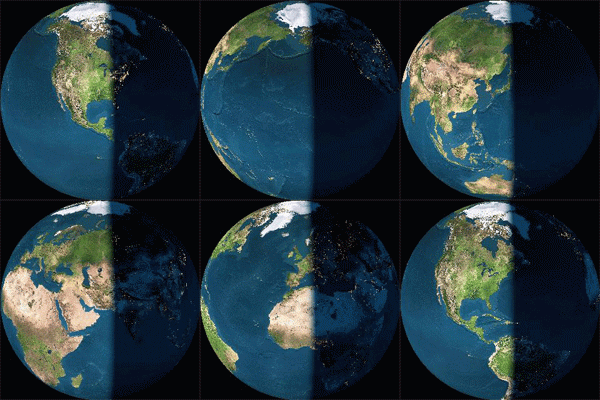
Spring Equinox: Weather Journal or Science Article
1. The first day of spring is here. Here's what you should know about the spring equinox
https://www.cnn.com/2019/03/20/us/first-day-of-spring-2019-trnd/index.html
https://www.cnn.com/travel/article/spring-equinox-wxc/index.html
3. The spring equinox is Wednesday: 7 things to know about the first day of spring
https://www.vox.com/science-and-health/2019/3/18/18270887/spring-equinox-2019-vernal-march
4. Vernal Equinox 2019: Google Doodles Celebrate as Earth's Seasons Change
https://www.space.com/spring-equinox-2019-google-doodle.html
5. Vernal Equinox: The Science Behind the First Day of Spring 2019
https://weather.com/science/weather-explainers/news/2019-03-20-vernal-equinox-spring-2019
Sunday, February 3, 2019
C4 - Solids, Liquids, Gases and the Exploration of Matter Online Exploration
A. Introducing solid,liquid and gas
Please go to your Google Classroom accounts to watch the video :)
(Watch from 0:00 - 2:55)
1. Everything in the universe fits into 1 of 3 categories: it's either a _____, a ______, or a___.
2. True/False: Solids move about easily.
3. Explain the following statement: Even things that aren't moving, are actually moving. How is this possible?
4. If you had a super-powerful microscope that could zoom in on the tiny stuff that makes up matter, it would look like millions of little lumps.
Little : ________
Lumps: ________
B.
-Play the interactive game-
1. Describe the arrangement and movement of the particles as you change from a solid to a liquid. Describe the arrangement and movement of the particles as you change from a liquid to a gas.
2. Describe the arrangement and movement of the particles as you change from a gas to a liquid. Describe the arrangement and movement of the particles as you change from a liquid to a solid.
3. Pick 2 phase transitions and make a sketch of them. Describe whether energy is lost or gained in this transition.
C.
Watch the How Stuff Works Videos States of Matter Changes in State
C.
Watch the How Stuff Works Videos States of Matter Changes in State
1. What happens to the molecules of liquid water when it boils? Have you ever boiled water before? If so, what for? How would you describe the energy of the water before boiling and after boiling?
2. Explain the difference between boiling and evaporation. How are boiling and evaporation similar?
3. What is the boiling point of water in Fahrenheit (°F) and Celsius (°C)?
4. What is the melting point of rock? What is the melting point of water?
5. What happens to water molecules when they freeze into a solid? Have you ever witnessed water changing from a liquid to a solid? How would you describe the energy of the water before and after it froze?
6. At the 2:00 mark, estimate the volume of the liquid in the beaker, don’t forget units!
Sunday, January 13, 2019
Mass, Volume, and Density Videos
Volume is the amount of space occupied by an object; it's an object's size, and it's
measured in three dimensions: the x, the y, and the z.
The volume of an object can be measured with a graduated cylinder.
1. Volume Video
Mass is a measure of matter. Everything has mass; all solids, liquids and gases have mass because they are made up of molecules.
We measure the mass of an object with a triple beam balance.
2. Mass Video
1. The wood cube and an iron cube have the same _____ because they are the same size.
2. The iron cube is heavier or has more ____.
3. The more closely packed the molecules, the higher the _______.
4. To determine density, we must first measure the ____ with a triple beam balance.
5. Next, we find the ______ which has units mL for a liquid or cm3 for a solid.
6. Why did the oil float on top of the water?
4. Density: Sink or float video + review
1. If something is able to float we say that it is _______.
2. How is it possible for a very heavy cruise ship to float?
5. Density: Why does oil float on water? video and Q/A
1. Density is the measure of the ____ of an object per unit ______.
2. A log of wood floats on water because it is _____ dense than water.
3. A rock sinks because it is ____ dense than water.
4. A balloon rises because it is less _____ than the surrounding air.
5. Oil is ____ dense than the surrounding water so it floats.
Saturday, January 5, 2019
Mass, Volume, and the exploration of Density
Volume is the amount of space occupied by an object; it's an object's size, and it's measured in three dimensions: the x, the y, and the z.
Eureka! Volume and Density
The volume of an object can be measured with a graduated cylinder.
Mass is a measure of matter. Everything has mass; all solids, liquids and gases have mass because they are made up of molecules.
Friday, January 4, 2019
Science Article - Current Events
1. Adelie penguins poop so much, their feces can be seen from space
https://newsela.com/read/adelie-penguin-poop-space/id/48527/
2. Some reasons why humans lost their fur
https://newsela.com/read/humans-lose-fur/id/48272/
3. Climate change makes seas rise faster and faster
https://www.sciencenewsforstudents.org/article/climate-change-makes-seas-rise-faster-and-faster
4. Explainer: Why sea levels aren't rising at the same rate globally
https://www.sciencenewsforstudents.org/article/explainer-why-sea-level-rise-rate-varies-globally
5. Rising seas threaten thousands of world cultural sites
https://www.sciencenewsforstudents.org/article/rising-seas-threaten-thousands-world-cultural-sites
6. How three coastal communities are dealing with rising seas
https://www.sciencenewsforstudents.org/article/how-three-coastal-communities-are-dealing-rising-seas
7. Can Mere Mortals Gain Aquaman's Superpowers?
https://www.dogonews.com/2019/1/16/can-mere-mortals-gain-aquamans-superpowers
8. Don't Miss The Spectacular "Super Blood Moon" Eclipse On January 20
https://www.dogonews.com/2019/1/14/dont-miss-the-spectacular-super-blood-moon-eclipse-on-january-20
https://newsela.com/read/adelie-penguin-poop-space/id/48527/
2. Some reasons why humans lost their fur
https://newsela.com/read/humans-lose-fur/id/48272/
3. Climate change makes seas rise faster and faster
https://www.sciencenewsforstudents.org/article/climate-change-makes-seas-rise-faster-and-faster
4. Explainer: Why sea levels aren't rising at the same rate globally
https://www.sciencenewsforstudents.org/article/explainer-why-sea-level-rise-rate-varies-globally
5. Rising seas threaten thousands of world cultural sites
https://www.sciencenewsforstudents.org/article/rising-seas-threaten-thousands-world-cultural-sites
6. How three coastal communities are dealing with rising seas
https://www.sciencenewsforstudents.org/article/how-three-coastal-communities-are-dealing-rising-seas
7. Can Mere Mortals Gain Aquaman's Superpowers?
https://www.dogonews.com/2019/1/16/can-mere-mortals-gain-aquamans-superpowers
8. Don't Miss The Spectacular "Super Blood Moon" Eclipse On January 20
https://www.dogonews.com/2019/1/14/dont-miss-the-spectacular-super-blood-moon-eclipse-on-january-20
Thursday, January 3, 2019
Read a science based article. Learn how Science is happening in our daily lives and how it relates to you. You can get your information from a newspaper, magazine or from the internet.
It should be handwritten NEATLY or typed and shared with my pconsidine@pershing220.org account.
Follow these simple steps to make an A!
1) Summarize the article in 5-7 sentences (i.e. What is the article about?)
2) How does this affect us? (1 sentence min.)
3) Why is this important? (1 sentence min.)
4) How is this science related? (1 sentence min.)
5) Pick a science word and write its definition. Use a dictionary or www.dictionary.com
6) Draw a picture!
7) Make sure to include your source. i.e. Where did you get your information from? website url, magazine title and date, newspaper title and date
1) Scientists use theoretical number to settle exact weight of a kilogram
https://newsela.com/read/kilogram-redefined/id/47590/
2) Much of a proton’s mass comes from the energy of the particles inside it
https://www.sciencenewsforstudents.org/article/much-protons-mass-comes-from-energy-of-particles-inside
3) What makes Aquaman special? He can take a lot of pressure
https://www.sciencenewsforstudents.org/blog/technically-fiction/aquaman-can-take-the-pressure
It should be handwritten NEATLY or typed and shared with my pconsidine@pershing220.org account.
Follow these simple steps to make an A!
1) Summarize the article in 5-7 sentences (i.e. What is the article about?)
2) How does this affect us? (1 sentence min.)
3) Why is this important? (1 sentence min.)
4) How is this science related? (1 sentence min.)
5) Pick a science word and write its definition. Use a dictionary or www.dictionary.com
6) Draw a picture!
7) Make sure to include your source. i.e. Where did you get your information from? website url, magazine title and date, newspaper title and date
1) Scientists use theoretical number to settle exact weight of a kilogram
https://newsela.com/read/kilogram-redefined/id/47590/
2) Much of a proton’s mass comes from the energy of the particles inside it
https://www.sciencenewsforstudents.org/article/much-protons-mass-comes-from-energy-of-particles-inside
3) What makes Aquaman special? He can take a lot of pressure
https://www.sciencenewsforstudents.org/blog/technically-fiction/aquaman-can-take-the-pressure
Monday, December 17, 2018
Science Article "Volume"
1. Brace Yourselves, Winter Is About To Begin!
2. Ever wondered why days get shorter in winter?
https://newsela.com/read/winter-shorter-days/id/48115/
3. How wombats make their unique cube-shaped poop
https://www.sciencenewsforstudents.org/article/how-wombats-make-their-unique-cube-shaped-poop
4. Giant Prehistoric Penguins Once Swam Off The Coast Of New Zealand
5. This human-sized penguin isn't even the largest ancient penguin we know about
6. Maple syrup industry losing gallons due to trend of warmer temperatures
7. Recycling space pee and other waste is getting some serious studying
8. Brain size isn’t all that matters in animals
9. Carbon dioxide emissions will hit a record high globally in 2018
10. Global warming is shrinking river vital to 40,000,000 people
https://www.tweentribune.com/article/tween56/global-warming-shrinking-river-vital-40000000-people/
Read a science based article. Learn how Science is happening in our daily lives and how it relates to you. You can get your information from a newspaper, magazine or from the internet.
It should be handwritten NEATLY or typed and shared with my pconsidine@pershing220.org account.
Follow these simple steps to make an A!
1) Summarize the article in 5-7 sentences (i.e. What is the article about?)
2) How does this affect us? (1 sentence min.)
3) Why is this important? (1 sentence min.)
4) How is this science related? (1 sentence min.)
5) Pick a science word and write its definition. Use a dictionary or www.dictionary.com
6) Draw a picture!
7) Make sure to include your source. i.e. Where did you get your information from? website url, magazine title and date, newspaper title and date
It should be handwritten NEATLY or typed and shared with my pconsidine@pershing220.org account.
Follow these simple steps to make an A!
1) Summarize the article in 5-7 sentences (i.e. What is the article about?)
2) How does this affect us? (1 sentence min.)
3) Why is this important? (1 sentence min.)
4) How is this science related? (1 sentence min.)
5) Pick a science word and write its definition. Use a dictionary or www.dictionary.com
6) Draw a picture!
7) Make sure to include your source. i.e. Where did you get your information from? website url, magazine title and date, newspaper title and date
Sunday, December 16, 2018
Density, Mass, and Volume videos
1. If something is able to float we say that it is _______.
2. How is it possible for a very heavy cruise ship to float?
1. Write a brief summary of Archimedes' Principle.
Super Fun Investigation!!!
Make a density tower!!! Watch the videos below and make your own to explore the concept of density.
Take a picture of it, write down your observations and inferences, and you get two science article passes!!
Watch the videos on density then answer the following questions.
1) Describe density in your own words. Make up your own definition of density.
2) Compare/Contrast the molecules in an object that is very dense with the molecules in an object that has a low density. Draw a picture of the two objects and their molecules.
3) mass = 4.4 g volume = 2.2 mL density = ?
4) An object has mass of 450 g and a volume of 150 cm3, calculate its density.
5) a. Watch the video on measuring matter.
https://www.brainpop.com/science/matterandchemistry/measuringmatter/
b. Take the review quiz to assess your knowledge.
https://www.brainpop.com/science/matterandchemistry/measuringmatter/quiz/
Density = Mass/Volume
Mass is the measure of matter. Everything has mass. The bigger of the object, the more mass it has.
We measure the mass of an object with a triple beam balance.
Volume is the amount of space occupied by an object measured in three dimensions, expressed in cubic units.
The volume of an object can be measured with a graduated cylinder.
Density is a measure of how much mass is contained in a given unit volume (density = mass/volume). It is usually expressed in kg/m^3. Put simply, if mass is a measure of how much 'stuff' there is in an object, density is a measure of how tightly that 'stuff' is packed together.
Thursday, December 13, 2018
LAB #4 – Simple Machines Help Us (620)
Problem: What are the motions that each simple machine makes in order to make work easier?
Hypothesis: I predict that simple machines make work easier.... How?
Materials: various simple and compound machines
Results:
Name of the object
|
Purpose of the object
|
What kind of simple machine/s is it?
|
Draw a picture of the object
| ||||||||||||
1. Plastic drink top
| |||||||||||||||
2. chemistry tongs (2)
| |||||||||||||||
3. cabinet drawer track
| |||||||||||||||
4. scissors (2)
| |||||||||||||||
5.
| |||||||||||||||
6.
| |||||||||||||||
7. spray bottle (2)
| |||||||||||||||
8. microscope (3)
| |||||||||||||||
9. alligator clips (2)
| |||||||||||||||
10. flashlight
| |||||||||||||||
Analysis:
1) How do simple machines make our lives easier?
2) Pick three of the objects from the lab and explain how it would be like without them? How would you accomplish the tasks they help us with without them?
3) Go to your data table and label the fulcrum for each of your levers.
4) Find three simple machines at home and add them to your Results.
5) a. Sketch a picture of each simple machine; use arrows to show the motion of each.
b. How does each simple machine change the direction, distance, or magnitude of a force?
5) a. Sketch a picture of each simple machine; use arrows to show the motion of each.
b. How does each simple machine change the direction, distance, or magnitude of a force?
Conclusion
What was your problem?
|
Restate your hypothesis. Was it right? wrong? why or why not?
|
What did you learn in this lab?
|
What did you like about this lab?
|
What were some challenges you had to deal with?
|
What could you do next with this problem? What other tests could you perform?
|
Write down any other additional thoughts, observations, inferences, etc.
|
Subscribe to:
Comments (Atom)